
Divorce Therapy for Men: Why Most Men Don't Get This Support
The number of men who go through a major separation without talking to anyone about it, beyond a lawyer, is higher than most people assume. Not because the experience is easier for them. Because the available scripts for how to handle a divorce tend to emphasise getting through it, making decisions, and moving forward, and those scripts don't usually include sitting down with someone and actually working through what's happening.
Divorce is one of the most disruptive experiences a person can go through. The research on this is consistent: in the Holmes-Rahe Life Stress Inventory, one of the most widely used frameworks for measuring life stress (Holmes and Rahe, 1967), divorce ranks second only to the death of a spouse. The impact on men is consistent with this. What is less consistent is the likelihood that a man going through it will find his way to support that addresses what he's actually dealing with.
What Divorce Actually Does
Separation involves the simultaneous loss of a partner, a household, a version of daily life, and often a future that was planned and expected. When children are involved, it also means restructuring the most central relationship in your life and navigating that restructuring through a legal process that is frequently adversarial.
For men specifically, divorce often also means a significant reduction in close social contact. Research from the Survey Center on American Life (Cox, 2021) found that nearly half of married men identify their spouse as their only close confidant, compared to about a quarter of married women. When that relationship ends, the loss of the primary emotional connection and the loss of the partnership happen at the same time, and the existing social network may not provide much room to process either.
None of this is unusual. All of it is worth taking seriously.
Why Men Often Don't Pursue Support
A few things tend to get in the way.
The framing around what divorce requires. The immediate demands of separation, legal, financial, logistical, are concrete and urgent. Attending to those feels productive. Sitting with the emotional reality of what is happening can feel like something that will sort itself out later, or like a luxury compared to the practical problems in front of you.
The absence of a clear model. Men going through divorce are less likely than women to have peers who have openly processed a separation. The conversations that happen among male friends after a divorce tend to involve practical logistics, distraction, and advice, rather than the kind of processing that actually moves things through. There is not always a clear sense of what it looks like to actually work through this.
The assumption that they are handling it. The presentation that says "I'm fine, I'm dealing with it, I'm keeping it together" is both genuine and misleading. Men often are keeping things together externally. The internal experience is something different.
Not knowing where to start. Therapy is more familiar as something other people do, or something for crises, than as a practical tool for navigating a specific and difficult life event.
What Individual Therapy After Divorce Actually Involves
Therapy after separation is not a process of being told what to feel or how to move on. What it actually involves depends on what the person brings, but in the divorce context it tends to include: making sense of what happened and why, processing grief and anger that don't always fit the timeline others expect, identifying patterns that may be showing up in the separation itself or that predate it, and building enough stability to make major decisions, about the children, the finances, the future, from a clearer place.
A pattern I see consistently in this work is that men arrive at therapy after months of managing, when the managing has stopped working well enough. The cost of that delay is usually not catastrophic, but it is real: the period between when support would have been useful and when someone actually pursues it is often a difficult one that didn't need to be as hard.
Before becoming a therapist, I spent several years as a law clerk in a family law practice. I have a clear sense of what the legal process around divorce and separation actually involves, what it can and cannot do, and what it tends to leave unaddressed. That background shapes how I work with people navigating these situations.
This Is Individual Work
Individual therapy in the divorce context focuses on one person's experience. It is not couples therapy, co-parenting mediation, or a place to work on the relationship. If you are at a point where the relationship is ending or has ended, this is work about you: your experience, your decisions, your next steps.
For men navigating high-conflict separation specifically, the communication tools and the clinical context are covered in more depth across the divorce and separation cluster on this site. A useful starting point is Co-Parenting with Someone You Don't Trust, and for the specific challenges of high-conflict dynamics, What Is High-Conflict Divorce and Why It Feels Different.
For men navigating betrayal trauma alongside or underneath the divorce, Betrayal Trauma in Men After Infidelity covers that specific territory.
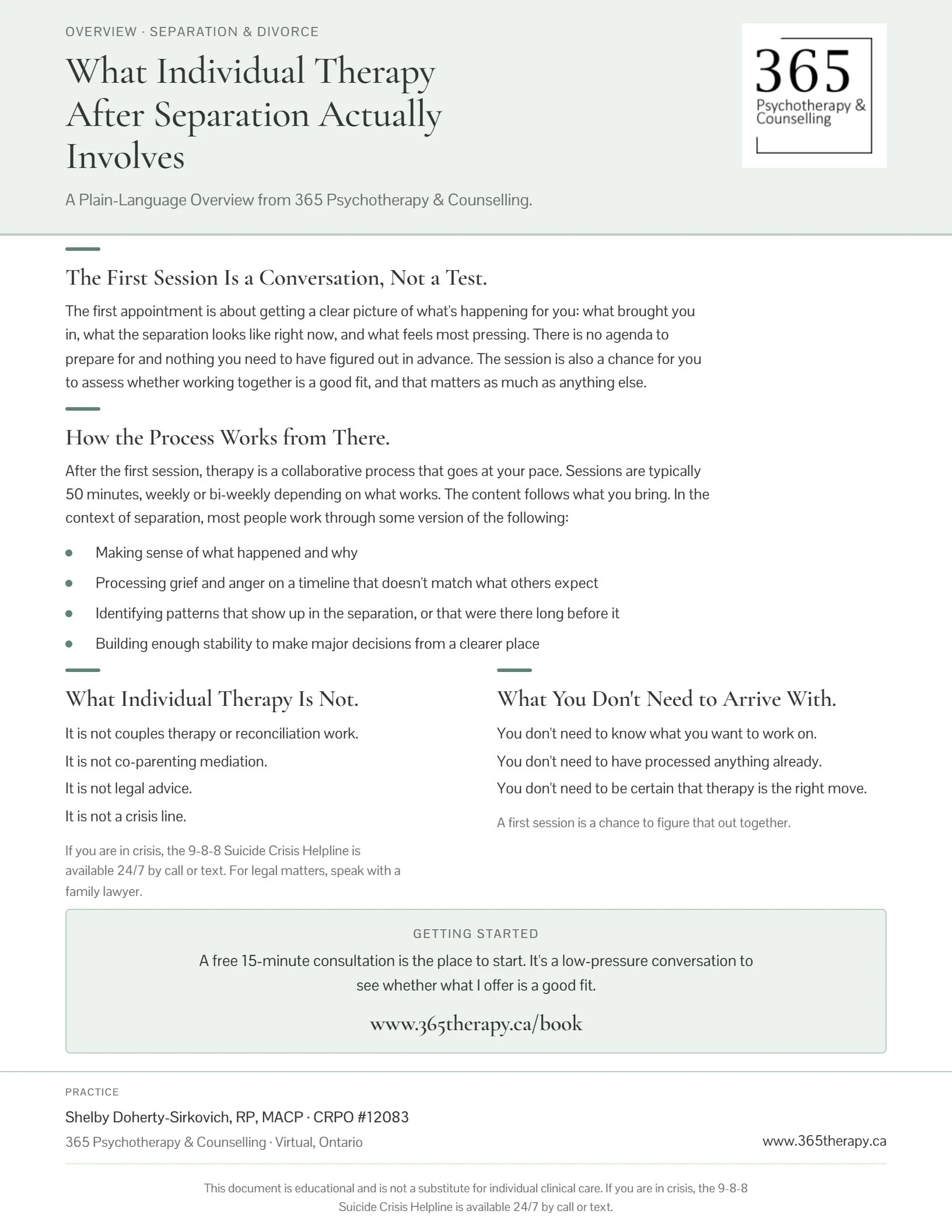
What Individual Therapy After Separation Actually Involves
A plain language overview that breaks down what happens and what it’s like.
Frequently Asked Questions
-
No. Individual therapy focuses entirely on one person's experience of the separation: the grief, the practical strain, the identity disruption, and the decisions ahead. Couples therapy works on the relationship between two people. If the relationship is ending or has ended, individual therapy is the appropriate form of support.
-
Yes. The evidence on this is fairly consistent: men are at elevated risk for social isolation, depression, and health deterioration following divorce, partly because the partner often served as the primary emotional support. Individual therapy addresses the gap that separation creates in that regard. The benefit is not dependent on being comfortable with the idea of therapy before you start.
-
Handling things externally and processing them internally are different things. Many men come to therapy while fully functional at work and with the children, because the internal experience is not matching the external presentation. Therapy is useful before things stop working, not only after. It is also useful for making major decisions, custody arrangements, financial decisions, housing, about the future, from a more settled place.
-
That is a very common starting point and not an obstacle. Most people navigating a major life transition don't arrive with a clear agenda. A first session is a conversation about what's happening and what feels most pressing. The structure develops from there.
-
No. Therapy is not only for people with a diagnosed mental health condition. A major life transition like divorce is a legitimate reason to seek support regardless of whether anything would be clinically diagnosable. If you are wondering whether what you're experiencing might have a clinical name, your family doctor, psychiatrist, or psychologist is the right person to speak with about that.
I work with adults across Ontario navigating divorce and separation, including high-conflict dynamics and post-separation patterns. My approach is trauma-informed and integrative, and I hold the Certified Clinical Trauma Specialist - Individual (CCTS-I) credential from the Arizona Trauma Institute. Before becoming a therapist, I spent several years as a law clerk in a family law practice, and that background shapes how I understand what people navigating these systems are actually up against.
If any of this resonates, a free 15-minute consultation is the place to start. It's a low-pressure conversation to see whether what I offer is a fit.
Book a free 15-minute consultation