
Sunday Night Anxiety: What It's Telling You
It starts somewhere around late afternoon. A low-grade tightening that doesn't have a specific cause, or has too many at once to identify. By evening, you're not quite present for whatever you're doing. Monday is not here yet, and already it is.
Sunday night anxiety, sometimes called the Sunday scaries, is common enough to have a name. It is also common enough to be dismissed as a personality quirk, or as something that is simply part of having a demanding job or a full life. But what it usually is, when it shows up consistently, is the body's anticipatory stress response running ahead of the week, and that consistency is worth paying attention to.
What Is Actually Happening
As Stanford biologist and neuroscientist Robert Sapolsky describes in his research on the human stress response, the nervous system does not distinguish well between a current threat and an anticipated one. When the body has learned to associate Monday with stress, conflict, overload, or something it needs to brace for, Sunday evening becomes the point at which the stress response starts to engage.
This is not irrational. It is the nervous system doing what it is designed to do: prepare in advance for what it predicts will be difficult. The problem is that this preparation does not actually make Monday easier. It makes Sunday harder while leaving the underlying conditions untouched.
The anticipatory anxiety response often looks different from acute anxiety. It tends to show up as a diffuse unease rather than a specific worry, a restlessness or low-level dread rather than a clear fear of something named. Some people notice it primarily in the body: tension in the chest or shoulders, trouble settling, an inability to be absorbed by whatever they are watching or reading. Others notice it as a background preoccupation that prevents them from being present.
What Sunday Night Is Usually Telling You
Consistent Sunday night anxiety is rarely about Sunday. It is about the relationship between Monday and what Monday represents.
Sometimes what it represents is straightforward: a genuinely overwhelming workload, a difficult colleague or manager, a commute or environment that has become a source of stress. The anxiety is appropriate signal for a situation that is actually difficult.
More often, it reflects something that has been building over a longer period: a cumulative load that hasn't been processed, a work environment that consistently exceeds what feels sustainable, an exhaustion that a weekend cannot repair, or a job or life arrangement that no longer fits the person living it. The Sunday feeling is the nervous system registering what the rational mind has been minimising or postponing.
A pattern I notice in practice is that people experiencing consistent Sunday night anxiety have often been telling themselves, for some time, that things will get better after a specific point, a project ends, the busy season is over, the children get a little older. When the anxiety persists across those transitions, it is often an indication that the source is systemic rather than situational.
What Doesn't Help (and Why People Try It Anyway)
Planning more. Using Sunday evening to get a head start on the week has a certain logic to it. If the anxiety is about Monday, addressing Monday seems sensible. What it usually does is reinforce the pattern: Sunday becomes a work day, which reduces the buffer between the week just ended and the one about to begin, which increases rather than decreases the cumulative strain.
Distracting from it. Filling Sunday evening densely, with social plans, screens, busyness, manages the surface experience without addressing what is underneath it. The anxiety returns the next Sunday, and the one after that.
Assuming it will pass on its own. Sometimes it does, when circumstances change. More often, the pattern habituates and becomes the new baseline. What feels like a stressful season can gradually become the shape of the week, every week.
What Often Helps
The most useful starting point is taking the anxiety seriously as information rather than as a problem to suppress.
Name what Monday represents. Not in a general sense, but specifically: what aspect of the week is the nervous system responding to? Is it a relationship, a workload, an environment, a role that doesn't fit? The more specific the identification, the more options exist for addressing it.
Create a genuine transition between Sunday and the week. This is different from a distraction. It is a deliberate boundary: a time on Sunday evening when the week is not yet allowed in. Some people build this around a regular activity, a walk, a meal, a practice, that signals the boundary to the nervous system. The transition needs to be consistent to work.
Look at the cumulative picture. If Sunday night anxiety has been present for months or years, the question worth asking is not how to manage the feeling but what the feeling is pointing at. Whether the answer is a change in workload, a conversation with a manager, a shift in how the week is structured, or something larger, the anxiety is more useful as a guide than as a problem to be solved in isolation.
Consider whether more support would help. Persistent anticipatory anxiety that doesn't respond to changes in circumstance, or that is connected to a wider pattern of chronic stress, overextension, or exhaustion, often responds well to individual therapy. Working through what is driving it and building the regulation capacity to interrupt the anticipatory response are things therapy can specifically address.
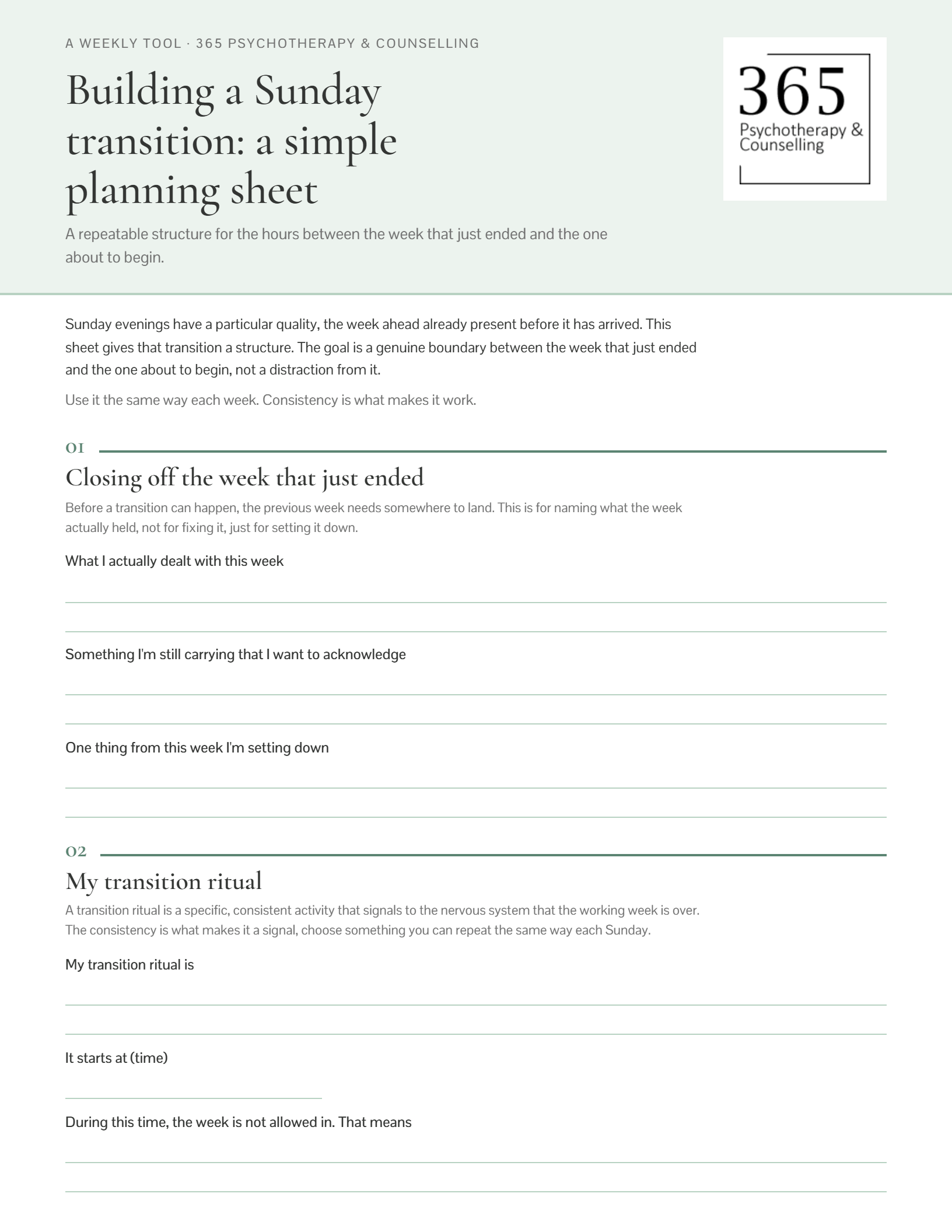
Building a Sunday Transition Worksheet
Taking control of your Sunday-Monday week transition in a reflective and purposeful way.
Frequently Asked Questions
-
It is common, but consistent Sunday night anxiety is worth paying attention to rather than normalising. Occasional pre-week unease is understandable. When it is a reliable feature of every Sunday, it is usually the nervous system signalling something about the week it is anticipating, and that signal is more useful as information than as something to push through.
-
The nervous system's anticipatory response doesn't require a specific named threat. If Monday has been consistently stressful, the body begins to respond to Sunday as the threshold of that stress. The anxiety may feel diffuse or hard to locate precisely because it is a predictive response rather than a reaction to something currently present.
-
For most people, using Sunday evening for work preparation makes the anxiety worse, not better. It collapses the boundary between rest and the working week, which reduces the nervous system's opportunity to genuinely disengage. A consistent transition point, a deliberate stop time after which the week is not addressed, tends to be more effective.
-
It can be one of the early indicators. Christina Maslach's foundational research on burnout identifies persistent emotional exhaustion, a growing sense of detachment from one's work or responsibilities, and a feeling that demands consistently exceed available resources as its core markers. Consistent Sunday night anxiety alongside difficulty recovering over weekends fits within that picture. If this resonates, it is worth discussing with a health professional.
-
If it has been consistent for several months, if it is significantly affecting the quality of your weekends, or if it is connected to a broader picture of chronic stress or overextension, speaking with a therapist or your family doctor is worth considering. Persistent anxiety that doesn't respond to changes in circumstances may benefit from support that addresses the underlying pattern directly.
I work with adults across Ontario navigating chronic stress, anxiety, and the kind of exhaustion that doesn't resolve with a weekend. My approach is trauma-informed and integrative, drawing from ACT, somatic work, psychodynamic therapy, and DBT based on what is most useful for each person. I hold the Certified Clinical Trauma Specialist - Individual (CCTS-I) credential from the Arizona Trauma Institute.
If any of this resonates, a free 15-minute consultation is the place to start. It's a low-pressure conversation to see whether what I offer is a fit.
Book a free 15-minute consultation